Nature Spirit Herbs co-founders James Jungwirth and Kari Rein sat down with JPR a few years back to talk all things seaweed: from how a chance visit to the Oregon coast in 1989 sparked a 33-year business, to the surprising health benefits, harvesting methods, and easy ways to work sea vegetables into your everyday cooking. Give it a listen and read below.
Listen to the Interview on JPR
Read the Transcript
Interviewer: This week we’re welcoming James Jungwirth and Kari Rein, the owners of Naturespirit Herbs in Williams. Good morning to you both. As a beach boy from San Diego, I spent many a day chomping on dry kelp off the beach — it was always a delicious snack. And as a home cook, I love adding kelp or kombu to soups for that umami flavor. I’ve actually put kombu into tomato sauce, and it gives you a wonderful saltiness and depth. I thought it would be interesting for our listeners to learn some of the health benefits and the different ways you can use seaweed in cooking. Tell us a little bit about your business — you do more than seaweed, right?
Kari Rein: Yes, we harvest a lot of seaweeds from the coast, and we also harvest dozens of wild medicinal plants.
Interviewer: How did you first decide to do this? Were you just out kayaking one day and had a business idea?
Kari Rein: Well, we went to the coast as soon as we moved here in 1989 and started just tasting all the seaweeds growing on the rocks. We had a child on the way and were looking for a way to make a living. So we harvested some seaweed that first summer, dried it, packaged it up, and took it to a local barter fair. It sold really quickly, and we thought — next year we’ll harvest more. And that’s how Nature Spirit Herbs was born.
Interviewer: I’ve had seaweed before in different recipes — in soups, wrapped in sushi — and I like it. But I’m thinking there’s probably a group of people who, when you say “here, try this seaweed,” they have to get past a hurdle first.
James Jungwirth: Oh yeah. Twenty years ago, hardly anyone had heard about seaweed. And there are still a lot of people who, when they think of seaweed, think of the smelly piles on the beach. But we harvest our seaweeds from what we call the gardens — the rocky intertidal areas. That’s like the garden. The smelly piles on the beach? That’s the compost pile.
Interviewer: So what was the original draw to that “crop,” so to speak?
James Jungwirth: Well, both Kari and I were avid eaters of seaweed when we moved out here. We wanted to go harvest our own, and then, like she said, we got the idea of harvesting it for other people. And here we are, 33 years later, still selling seaweed.
Interviewer: Where all do you market to?
Kari Rein: We sell to a variety of people — healthcare professionals, stores, individuals who order for themselves, and manufacturers who incorporate it into their products.
Interviewer: I was doing some background reading to prep for this and didn’t realize seaweed was considered one of the superfoods. Talk a little bit about the nutrition.
James Jungwirth: Seaweeds are some of the most nutritionally and therapeutically valuable foods on earth. They are probably the most concentrated source of minerals of any food that exists — all the minerals, all the trace minerals. They’re also likely the highest source of iodine of any food on earth. They contain sulfated polysaccharides, which have a number of wonderful health benefits. Including just a little bit of seaweed in your diet every day is probably one of the best things you can do for your health and longevity.
There’s been a large body of research over the last 10 to 30 years showing that seaweeds can help promote thyroid health, cardiovascular health, and immune system health. They help move heavy metals and other toxins out of the body and help regulate blood sugar. I could go on and on. If people are interested in learning more, they can visit our website and read some of the articles we have there, or just search “seaweed health benefits research” online — you’d probably be pretty amazed by what you learn.
Interviewer: Let’s talk a little bit about recipes, to introduce some newcomers to seaweed. Kari, can you speak to the food side of things?
Kari Rein: Seaweed can be used in many different ways. It’s tasty, and the different kinds have different flavors, textures, and colors — there are red, brown, and green seaweeds. Some can be eaten right out of the bag, like the kelp fronds and sea palm we have as samples today. Those are snackable — kids love them. We also sell sea vegetables that need to be cooked and can be used in soups, stir-fries, and marinades. And we produce seaweed powders that can be used as a condiment — sprinkled on cooked vegetables, salads, rice, soups, or even popcorn.
Interviewer: (tasting a sample) What am I trying here?
Kari Rein: That’s kelp fronds.
Interviewer: This is delicious! It’s like a snack — salty and crispy, like a chip. Instead of grabbing a bag of chips, grab something healthy for you!
Kari Rein: Exactly — they’re chip-like, salty, and crispy.
Interviewer: Is this just natural salt? You don’t add any?
Kari Rein: We don’t add any salt. This variety has a high dry-down ratio — about ten to twelve pounds fresh to one pound dried — so it’s very concentrated in natural salts. It’s also really high in potassium in addition to sodium.
Interviewer: Other than snacking on it, how would you use this in a recipe?
Kari Rein: We also sell it as a powder, and it’s amazingly good in baked goods. And of course, as I mentioned, just as a sprinkle on top of food, in soups, or on popcorn. It’s an easy way to get it into your diet every day.
Interviewer: Was the decision to live in Williams related to your business, or was that a happy accident?
James Jungwirth: We mostly moved to Williams because we had kids on the way and wanted to raise our family there. There were great homeschooling options and a really nice community. The seaweed operation grew from there. I go out to the coast with a team of harvesters every morning during the season, and we send a truckload of seaweed back to Williams, where Kari is waiting with the drying crew to hang it all up. We have about 900 yards of outdoor drying lines.
Interviewer: Is your business primarily mail order or retail?
James Jungwirth: We’re primarily a mail order business, doing business across the country.
Interviewer: Do you sell to any restaurants?
Kari Rein: Yes, we do sell to some restaurants. There’s an excellent restaurant here in town called Moss — they work mostly with wild foods, so our products fit right in.
Interviewer: For a fun “gateway” recipe, I made a Japanese seasoning called furikake — super easy. Half a cup of toasted sesame seeds, a little salt, a little sugar, and then chopped nori. You can add bonito flakes, chili flakes, all kinds of things. You can put it on raw tuna for poke, on salads, soups, sandwiches. It’s a really fun introduction for people who may be unfamiliar with these products.
Interviewer: Is there a recommended therapeutic amount for someone wanting to bump up their nutrition?
James Jungwirth: Just in general, we recommend about three to five grams of dried seaweed per day — that’s roughly a half to one ounce of fresh seaweed. That amount is modeled on the Japanese diet. The Japanese are some of the healthiest and longest-lived people in the world, and that’s about how much they eat daily. The snackables and powders make it easy to use a little bit every day. The cookable varieties are more of an once or twice a week thing, but for daily use the powders, snackables, and even seaweed capsules work well.
Interviewer: Are there good areas along the Southern Oregon coastline to find seaweed, or is it pretty localized?
James Jungwirth: Seaweed grows everywhere there are rocky intertidal areas exposed at low tide. On the Oregon coast, you can harvest about one gallon per day between March 15th and June 15th, with a limit of three gallons per year for personal use. You can also pick up any amount of drift seaweed — anything already washed off the rocks. Just look at maps for headlands and rocky intertidal areas, get a tide table, and go for it.
Interviewer: Are there many different types you can harvest here?
James Jungwirth: There are dozens of edible seaweeds, but we primarily focus on eight different species of intertidal seaweeds, plus bull kelp, which grows further offshore.
Interviewer: Any other recipes you’d like to share?
Kari Rein: Adding seaweed or seaweed powder to baked goods is surprisingly wonderful — it makes a really nice addition to a sweet pie or cake. It adds a savory, umami depth of flavor, even with fruit. Cookies, pies, you name it.
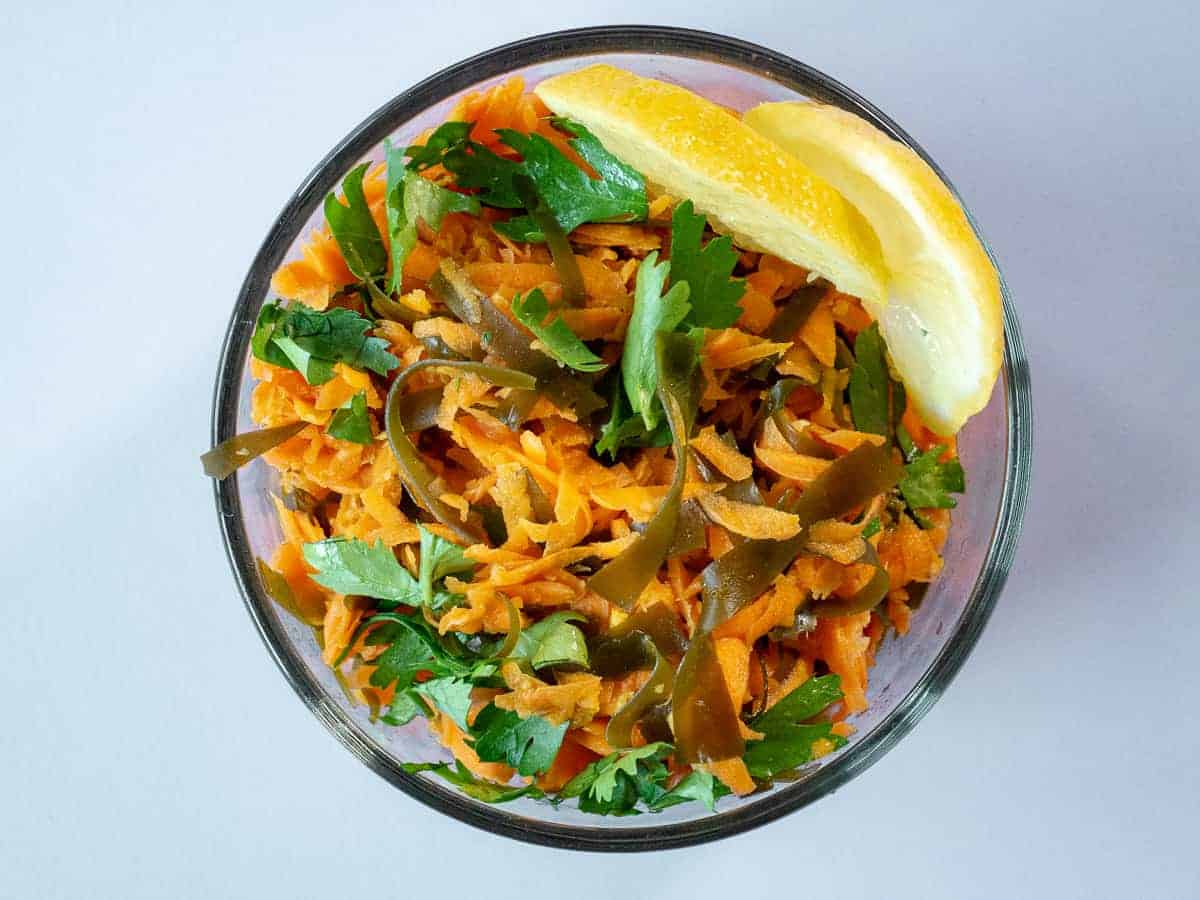
Another favorite of ours is making a marinated cooked seaweed side dish. Cook the seaweed until it’s as soft as you like — wakame takes about 30 minutes, kombu about an hour, sea palm maybe 20 to 25 minutes — using just a little bit of water so it all absorbs. Once it’s cooled, add olive oil, garlic, soy sauce, ginger or cayenne, and other spices. It makes a wonderful side dish alongside vegetables.
Interviewer: Did your kids take to seaweed growing up?
Kari Rein: Kids actually love seaweed — almost all kids we’ve met do. Dried seaweed is especially popular. We were lucky to be able to bring our kids to the intertidal zone when they were little. They learned about it, and when they got older, they helped us harvest.
Interviewer: How many people do you take out for harvesting?
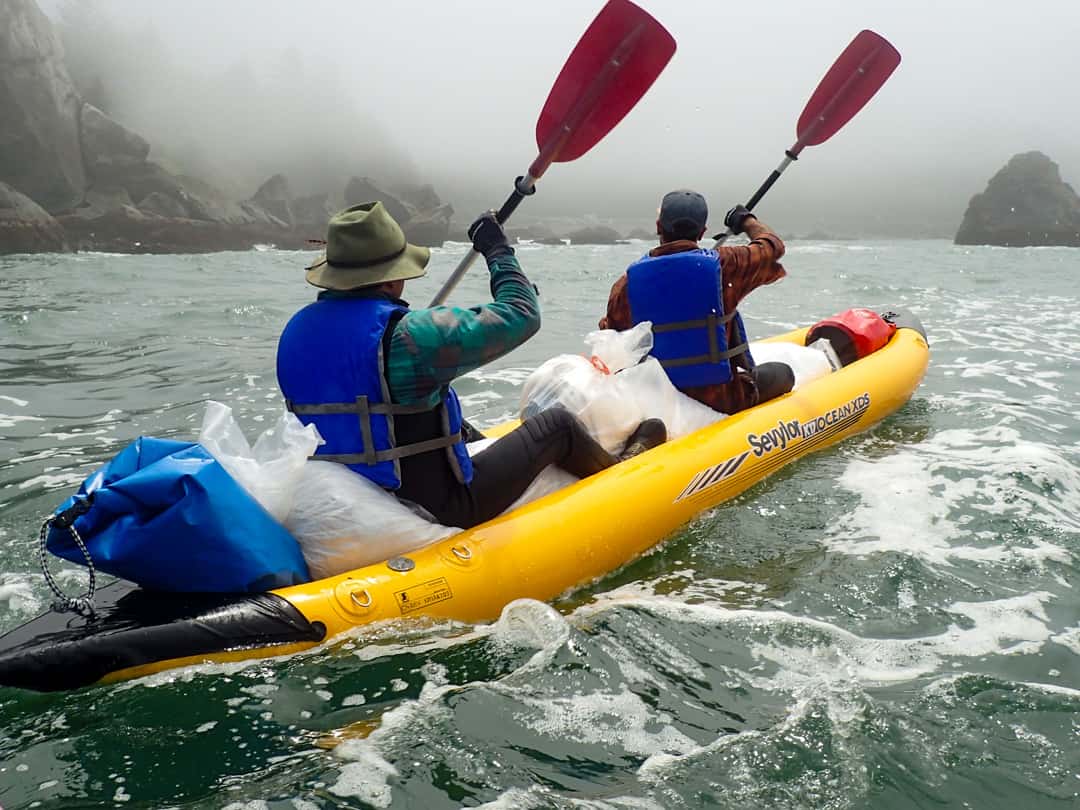
James Jungwirth: Typically I’ll bring three helpers. We have two kayaks, two people in each.
Interviewer: Are you actually in the water, or are you in the kayak?
James Jungwirth: We access the harvest areas by kayak — paddle out, park them, and then we’re on foot in wetsuits with our harvest gear. We load everything back into the kayaks. It’s always fun getting in and out through the surf. There’s just nothing like being out in the intertidal at dawn with the rocks covered in life.
Interviewer: What’s the harvesting season like?
James Jungwirth: We harvest mostly during the summer months when the weather is good for drying. The seaweeds are at their peak in June, July, and August. Harvesting is actually just a part of the total work — there’s a tremendous amount of manual labor involved: hanging it up to dry, taking it down, trimming, sorting, and packaging. We hire a lot of help for all of that. We harvest during the summer and build our inventory for the year, then sell throughout the rest of the year.
Interviewer: Is there a peak season like with fruits and vegetables, where quality is at its best?
James Jungwirth: Exactly. They really start growing in April and May and are full size in June, July, and August. As you get later into the season, quality starts to decline. But there’s always some seaweed out there to harvest for home use.
Interviewer: And the harvest limits we mentioned — those are for personal use only?
James Jungwirth: Right. The Oregon rules are for personal use. We do our commercial harvesting mostly on the Northern California coast, just over the border, where we hold a commercial harvest permit. In California, you’re allowed ten pounds per day — every day, ongoing — which is about a bucket full. You do need a fishing license, though you can get a day permit. So anyone interested can head down, get a day fishing permit, and harvest some seaweed.
Interviewer: Well, we’ve been speaking this morning with James Jungwirth and Kari Rein, owners of Naturspirit Herbs in Williams, Oregon. We’ve been talking about seaweed — the different ways you can harvest it and use it in your diet. We’ve both had seaweed and we like it, and we encourage you to try it if you never have. Thank you both for being here this morning.
Kari Rein: Thank you.
James Jungwirth: Thank you for having us. It was a pleasure.